

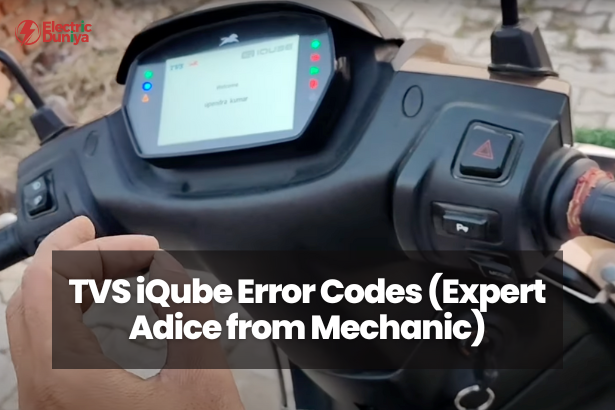
Have you ever been ready for a ride, kicked on your TVS iQube, and been greeted by a cryptic “E03” flashing on the dashboard?
I know exactly how that feels—my heart skips a beat, adrenaline kicks in, and I brace myself for a weekend repair saga.
Over time, I’ve learned that most of these codes are harmless, and understanding them can save time, money, and stress.
Here’s your smooth, friendly guide to everything you need to know about TVS iQube error codes, grounded in real-life experience and practical insights.
What Are These Error Codes and Why Do They Matter
These alphanumeric codes are the iQube’s way of saying, “Something’s off—but maybe not dangerous.” They represent alerts from subsystems like the battery, charger, motor control, or security unit.
- Some mean minor glitches.
- Others signal issues needing prompt attention.
- A few are rare but serious, like controller communication faults.
In short, Error codes help your scooter talk to you. And once you hear them clearly, it’s much easier to handle them.
Common Error Codes & What You Can Do
Here are the ones you’re most likely to encounter—and what you should do when they pop up:
E01 – Battery Voltage Mismatch
- What it means: Your scooter’s voltage readings don’t align with expectations.
- Likely cause: Low battery or momentary sensor hiccup.
- Quick fix:
- Charge to at least 80%.
- Turn the scooter off, wait 10 seconds, and restart.
- If it persists, visit a TVS service center—it could be a sensor or module issue.
Personal note: I’ve seen E01 during cold mornings. A full charge and a quick restart usually do the trick.
E02 – Battery Temperature Alert
- What it means: The Battery is either too hot or too cold.
- Likely cause: Extreme weather.
- Quick fix:
- Shift parking location—find shade or shelter.
- Let the battery reach an optimal temperature (15–40 °C).
- If still showing: Get diagnostics—possible BMS problem.
My experience: On scorching days, E02 showed up until I moved the scooter inside. A 20-minute break cleared it right up.
E03 – Motor Controller Fault
- What it means: Communication with or operation of the motor controller is compromised.
- Likely cause: A software bug, wiring issue, or internal fault.
- Quick fix:
- Fully power down the scooter and restart.
- Take a short test ride to check responsiveness.
- If it comes back: You’ll likely need a service visit; they may flash or replace the unit.
Personal takeaway: I got lucky once—reboot fixed it. But the second time, the controller was at fault and needed professional attention.
E04 – Charger Interface Error
- What it means: There’s an issue with the charging port or cable.
- Likely cause: Loose connection, damaged cable, or port corrosion.
- Quick fix:
- Disconnect and reconnect the charger.
- Inspect for dirt or damage.
- If it persists, replace the cable or inspect the port at a service center.
Real case: I once had a worn-out cable that triggered E04 mid-charge. A replacement cable cured it.
E05 – CAN Bus Communication Failure
- What it means: Data lines connecting the scooter’s systems aren’t talking properly.
- Likely cause: Loose connector, wiring fault, or module glitch.
- Quick fix:
- Power cycle the scooter fully.
- Ensure no accessory is interfering.
- If it persists, wiring checks and diagnostics by experts are needed.
Story: I got stranded when E05 showed up. A full shutdown brought life back, but a loose plug caused the ongoing issue.
E06 – Security Module Alert
- What it means: The scooter’s anti-theft system detected a fault.
- Likely cause: Key mismatch, sensor disabled, or system bug.
- Quick fix:
- Power cycle properly using the original key.
- Ensure the key fob battery is fine.
- If still active: Let the dealer reset or reprogram the security module.
Heads-up: I got E06 when my spare key fob was low on battery. Swapping it fixed things quickly.
Troubleshooting: The Easy vs. The Expert Cases
Do-It-Yourself Fixes
- Power cycle or rinse-recharge strategy work wonders.
- Double-check wiring and accessory attachment.
- Monitor behavior after weather changes or battery charge.
When to Get Help
- Persistent codes: No restart or repair effect.
- Performance is dropping: sluggish throttle or limp-mode activation.
- Safety-related alerts: Charger, controller, or bus faults.
My rule: Diagnose first. If reboot or recharge doesn’t help after two tries, schedule a service visit.
- Minor codes (E01, E02): most times, manageable at home.
- Mid-range codes (E03, E05): a chance to fix at first, but may require professional input.
- Major codes (E04, E06): usually need hardware or software service.
My takeaway: For the first two levels, I always try a reset or recharge. If it’s fooling around after that? Dealer diagnostics, it is.
Final Thoughts
Error codes on the TVS iQube are not signs of doom—they’re your scooter’s way of sending out an SOS. If you learn to interpret them, you’re empowered to fix many things on your own, avoid unnecessary visits, and stay safe.
I’ve made mistakes—ignored codes, tried patch repairs, delayed service—but I’ve also learned a lot. Now, I rarely get phased by an E01 or E02, and I know exactly when it’s time to get professional help.
So, next time E03 or E05 flashes at you, don’t panic. Read, reset, record—and if it won’t clear, take action. You’ve got this. And by the way? Your scooter’s not broken—just communicating. Now you’re ready to speak its language.