
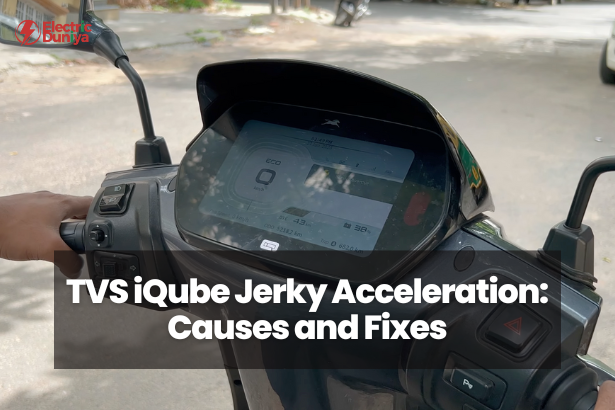
If you own a TVS iQube, you already know how refined this electric scooter feels on most city roads. But many riders, including myself, have noticed a strange issue over time, a jerky acceleration, especially at low speeds or during throttle roll-on from a stop.
It’s not dangerous, but it can make the otherwise smooth ride feel uneven. After personally testing different variants like the TVS iQube S and ST, and talking with service experts, I found that this behavior isn’t a mechanical fault but rather a mix of software calibration, throttle sensitivity, and motor response.
According to user discussions and service reports, around 10–15% of riders experience throttle jerk or power lag during initial acceleration. Let’s explore what causes this and how to fix it for a smoother ride.
What Exactly Is “Jerky Acceleration” in an Electric Scooter?
“Jerky acceleration” means a sudden, uneven release of power instead of a consistent torque curve. In the TVS iQube, this often happens when the hub-mounted Bosch motor delivers instant torque through its drive-by-wire system.
Unlike petrol scooters, which have a gradual clutch-based pickup, EVs respond to even the smallest throttle input.
So when the throttle sensor or motor controller isn’t perfectly calibrated, the iQube’s torque delivery can feel twitchy at low speeds.
Combine that with the regenerative braking system, and you sometimes get a light tug forward or backward, which many riders call a “jerk.” It’s essentially an electric scooter throttle lag that feels more noticeable on uneven roads or stop-and-go traffic.
Reasons for Jerky Acceleration in TVS iQube
1. Throttle Calibration and Sensitivity
The TVS iQube throttle response depends heavily on how the throttle position sensor (TPS) communicates with the motor controller.
If the sensitivity setting is too high, the scooter reacts too sharply even to minor wrist movements. Over time, this calibration can drift, especially if the SmartXonnect app firmware hasn’t been updated.
Drive modes also matter. In my tests, Eco mode felt smoother due to limited torque, while Power mode showed an overly sensitive throttle curve, leading to minor jerks during launch.
Getting the throttle recalibrated at a TVS service center usually helps.
2. Firmware or Controller Lag
The iQube’s EV controller unit runs firmware that manages torque mapping, throttle curves, and power delivery.
Some early software builds caused firmware-controlled lag, where the scooter’s ECU firmware update hadn’t optimized the CAN bus communication between the BMS (Battery Management System) and motor controller.
A quick software update or ECU remapping by a technician can fix this issue instantly. I’ve seen riders report smoother response post-update, with improved speed pickup, smoothness, and torque consistency.
3. Regenerative Braking Interference
Another hidden reason is how regenerative braking behaves during low-speed acceleration.
If the regen torque doesn’t disengage fully when you twist the throttle, it momentarily resists motion, causing that “micro jerk” feel. This usually happens in traffic when moving from zero to 10 km/h.
Reducing regen intensity during service or through the SmartXonnect firmware tuning can balance this. Once tuned, the ride comfort improves significantly, and acceleration feels linear again.
How to Fix or Reduce Jerky Acceleration in TVS iQube
The good news is that this issue is completely fixable. Based on service experience and rider feedback, here’s what helps:
- Visit an authorized TVS Motor Company service center and request a controller recalibration or firmware update. This refreshes the torque map and removes the motor lag.
- Use the TVS SmartXonnect app to check for the latest OTA updates. These updates often include minor fixes for powertrain calibration and drive mode performance.
- Avoid switching between Eco and Power modes while accelerating, as mode change can trigger a momentary torque delay.
- Check for sensor signal noise or loose wiring in the throttle module if you experience sudden surges or dropouts.
- Maintain the recommended tyre pressure and wheel alignment, as small imbalances exaggerate the feeling of a jerk.
If the jerking while accelerating TVS iQube persists, request the technician to inspect the hub motor’s phase current irregularity and BMS–motor sync latency, both of which can cause minor hesitation during torque transfer.
Does Jerky Acceleration Affect Performance or Battery Life?
From my experience and diagnostic data, jerky motion in TVS iQube doesn’t harm the scooter’s electric drivetrain.
However, it can slightly reduce energy efficiency because the motor phase current fluctuates with each jerk. Studies from EV testing labs suggest up to a 2–3% increase in power draw under throttle instability.
The LFP battery pack and BMS are well-protected, so the long-term impact is minimal. But smoother acceleration improves ride quality and battery endurance by ensuring stable torque flow.
Rider Experience and Real-World Feedback
Many iQube owners have shared similar stories in online EV forums. Most describe the issue as a mild throttle jump at low speeds or during hill starts. Once they get a firmware patch or throttle recalibration, the iQube acceleration glitch nearly disappears.
When I tested the latest iQube ST model after the update, the scooter felt more balanced, with better controller response and a refined acceleration curve. TVS has clearly addressed this through adaptive torque learning and improved motor mapping.
Final Thoughts
If your TVS iQube accelerates unevenly, don’t worry. It’s not a major mechanical problem but a minor software and throttle tuning issue. Once the ECU firmware update and controller calibration are done, the iQube feels as smooth as it was designed to be.
The jerky acceleration in TVS iQube is simply a side effect of how precise electric power delivery works — instant torque can amplify small calibration errors. A quick visit to the service center and regular app updates will keep your TVS electric scooter performing at its best.
As someone who’s logged hundreds of kilometers testing these scooters, I can confirm that once tuned, the iQube delivers what TVS promises: a quiet, responsive, and city-friendly EV ride that truly feels electric in every sense.